


Antarctica is one of the most incredible places on the planet. It has rugged landscapes, abundant wildlife, and endless opportunities for the unexpected. And, because the white continent is so unique, there are a few things you need to know before visiting Antarctica to make the most of your journey.
From when to book, to what to pack, to where you’ll go when you get there, here are a few points to keep in mind as you plan your epic adventure.
Making Reservations
The first step in any journey – booking your trip! To ensure you have the most enjoyable time possible, it’s important to find the right size ship and to make your reservations on time.
Choose The Right Cruise
IAATO (International Association of Antarctica Tour Operators) regulates tourism operations in Antarctica, controlling how often ships can visit sites and how long they can stay. In addition, they also mandate that no more than 100 guests are onshore during excursions.
Consequently, the larger the ship you book, the lesser the time you will spend on land since they’ll need to rotate visitors to ensure everyone gets an opportunity to land. Larger ships are also limited on what sites they’re allowed to visit. And, ships with over 500 guests aren’t allowed to land at all!
Don’t worry, there are plenty of small vessels to choose from! I, personally, traveled on the National Geographic Orion and was pleased with the multiple activities on shore each day.
Book Early
Book your cruise a least a year or more in advance because there are a limited number of ships allowed to travel to Antarctica during its short summer season (December through March). So, booking early will ensure you’re able to travel with your preferred cruise vessel and secure your desired accommodations.
While some cruise companies (such as National Geographic) include all excursions and activities in the price of the voyage, other companies operate like an a la carte menu. So, if you want to make sure you’re able to kayak, paddleboard, camp, or hike during your journey with those carriers, you must book activities early as well.

Preparing For Your Journey
Now that you’ve booked your once-in-a-lifetime adventure, it’s time to prepare for your journey! From what to pack to how to survive the Drake Passage, there are a few things to know before visiting Antarctica to make your trip more comfortable.
Pack The Right Gear
When you think of Antarctica, images of sub-zero temperatures and frostbite flash through your mind. But, temperatures during the southern hemisphere’s summer months are much milder than that. Temperatures are in the mid-30’s Fahrenheit with nearly 24 hours of daylight.
To stay warm, there’s no need to go out and spend hundreds on expedition gear. Snow pants, thick socks, and a thermal layer are more than enough to keep you toasty. And, most expedition companies will give you a warm jacket to keep so there’s no need to bring one (which will save you lots of room in your luggage!)
Also, because most zodiac landings require you to walk through shallow waters to reach the shore, you’ll want a comfortable pair of waterproof boots.
And finally, nearly 24 hours of daylight means plenty of chances to get sunburnt. So, make sure you bring ample sunscreen and apply it liberally before onshore excursions.
Keep Essentials Close
Nothing is worse than lost luggage. And, when you’re headed to a destination like Antarctica, not having the necessities can ruin your trip. So, bring the essentials with you in your carry-on to ensure you have what you need should your luggage disappear.
A few items I recommend having in your bag include any medications, a thermal layer, snow pants, warm socks, and your camera with memory cards and batteries. Then, wear your boots on the plane. Sure, it may be a bit cumbersome but you’ll thank me when you don’t have to borrow some that are two sizes too big and leave you with blisters.
Avoid Seasickness
To get to Antarctica you must cross the Drake Passage. Famed as the roughest waters in the world, the 600-mile stretch of sea often has waves over 30-feet high (which is no fun during the nearly two-day journey across).
In order to avoid getting seasick, do the following:
- Choose a cabin near the center of the ship to avoid the pitch and roll, and try to get one with a balcony for more light and fresh air. Also, book on a modern vessel with stabilizers to help compensate for rough waters.
- Pack anti-nausea medication like Dramamine or Bonine. Guest services will usually have anti-nausea medication free of charge, so you can call them in a pinch.
- Many people use patches, like Transderm Scop. If you choose to go that route, I highly suggest you test them before your trip. In some cases, they can have undesirable side effects like dry mouth, dizziness, confusion, and blurred vision.
- Eat nausea-reducing foods such as green apples, saltines, and ginger ale.
- Keep your eyes on the horizon to give your brain a point of reference for the motion.
And my biggest piece of advice – invest in a Relief Band! This modern miracle releases a specific pattern of pulses that stimulate your median nerve. The pulses create a signal to the part of your brain that controls nausea, creating a rebalancing effect. And, unlike patches and pills, the Relief Band is non-drowsy and drug-free.
There are two kinds to choose from – the original and the second generation. Sure, the second generation looks a lot cooler. But, I found the original version to be more effective than its sexy successor. And trust me, that’s important! Mine not only saved me from getting sick, but it also helped my dad and a fellow passenger (who looked like death warmed over when she put it on, and she was fine less than 5 minutes later!)

Once Onboard
You’re booked, you’re packed, and now you’ve finally made it aboard your ship! Now the real journey begins.
Get Cleaned Up
Once you find your cabin and get unpacked, grab a quick shower and a shave before you hit the Drake Passage. Because once you’re in rough waters, it’s extremely difficult to do either. And, feeling grubby for two days isn’t the tone you want to set for the rest of your trip.
You’ll also be asked to decontaminate your gear. That means anything you plan to bring onshore with you (boots, pants, jacket, tripod, etc) needs to be thoroughly scrubbed, vacuumed, and rinsed in disinfectant. The IAATO guidelines are strict to ensure the safety of Antarctica’s wildlife, who haven’t been exposed to the germs and diseases found elsewhere in the world.
Comfort Around The Ship
Bring warm and comfy clothing to be worn around the ship, since that’s where you’ll spend the majority of your time. Warm leggings, a pair of Uggs, a light jacket, etc are great options to have on hand. The atmosphere tends to be very casual, so comfort is key. And, unlike many other cruises, there’s no formal evening so you can leave your dress clothes behind.

Onshore Excursions
Now for the biggest adventure of all – setting foot on Antarctica! There’s truly nothing like it. But before you do, here are a few pieces of advice to help you make the most of your time in this otherworldly wilderness.
Respect the Wildlife
As you can imagine, the IAATO has some strict guidelines for watching wildlife in Antarctica. These rules are aimed at protecting the native species and not causing any disruption to their natural behaviors.
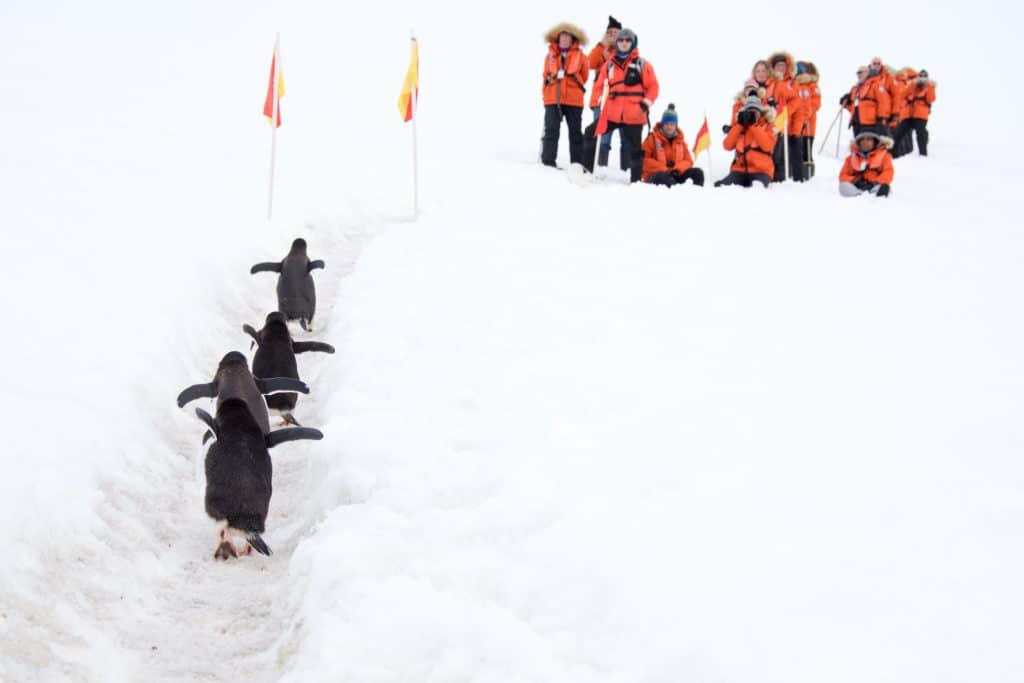
One of the most important things to remember is to maintain a 15-foot distance between you and any wildlife. That can become difficult when animals become curious and approach you to investigate. In those instances, it’s ok to be closer so long as they approach you and not the other way around.
You also want to avoid causing undue stress to local wildlife, which is especially important with penguins who are molting or nesting. Those two activities, in particular, expend an immense amount of energy. And in environments like Antarctica where calorie conservation is key, it can greatly affect the animal’s survival.
Finally, avoid walking on penguin highways. These are trails penguins create to walk to and from their nesting grounds, and people walking on them can create huge holes. That can be a death sentence if a penguin falls inside your boot print and is unable to get out.
Keep The Surroundings Clean
In addition to decontaminating your gear, you should keep Antarctica clean and untouched. That means you should never leave trash and pick up anything you find that’s been left by someone else. For instance, it’s easy to drop your chapstick if you’re pulling gloves out of your pocket. Or, you can lose a wrapper when you’re pulling out your camera gear. Just remain vigilant of yourself and others so that nothing is left behind.
Watch Your Step
There are no medical facilities in Antarctica and there’s only so much a ship’s doctor can do. So, watch your step and help other passengers who may be struggling. The ground can be slick and uneven, and if a fall results in a serious injury that means the ship must turn back to civilization and the trip is over for everyone.
In addition to watching out for each other, be vigilant for wildlife and vegetation. You’d be surprised how easy it is to accidentally step on a nesting penguin. And, contrary to what you may think, there are areas with plants in Antarctica. But, trampling through them with your boots can cause irreparable damage or years of regrowth. So, the IAATO has guidelines for protecting natural areas as well.
Be In The Moment
Finally, make sure to put down your camera and take the time to appreciate the wonders around you. Antarctica is a photographer’s dream! It’s awe-inspiring, immense, and simply unimaginable. So, it’s only natural to want to grab your camera and capture each and every minute of it. Trust me, I get it.
But, fight the urge to always be behind your lens and be in the moment instead.
Antarctica is a once-in-a-lifetime experience and it’d be a shame to return and realize you only saw it through a viewfinder. Instead, breathe in and marvel at the wide expanse of the horizon. Slide down a snowy hill on your bum. Or, just sit back and watch the penguins go about their entertaining routines. Take time to revel in all the sights, smells, sounds, and textures around you.
There are a lot of things to know before visiting Antarctica, but these are the most important ones to ensure you make the best of your time on the white continent. So, pack your adventure pants and get ready for the journey of a lifetime!
Have you been to Antarctica before? What are some pieces of advice you’d share? Comment below, I’d love to hear them!
You May Also Like:
» Picture Perfect Reasons To Visit Antarctica
» Ultimate Winter Packing Guide
» Ideas For Your Own Bucket List

Leave a Reply