

We’re all familiar with the most iconic Disney castle. For most of us, it conjures up memories of our childhood and watching whimsical cartoons on our living room floors. If you were really lucky, you may have even been able to see it in person! But what about the real story behind this symbol of our youth?
You may not be aware, but Disney’s Sleeping Beauty Castle is actually inspired by a real-life castle in Schwangau, Germany. Neuschwanstein Castle is the most visited castle in the country, and one of the most popular destinations in Europe. It also happened to be on my bucket list! So I booked a tour to learn more about its history. And what I found out will surprise you.

Disney’s famous Sleeping Beauty castle.
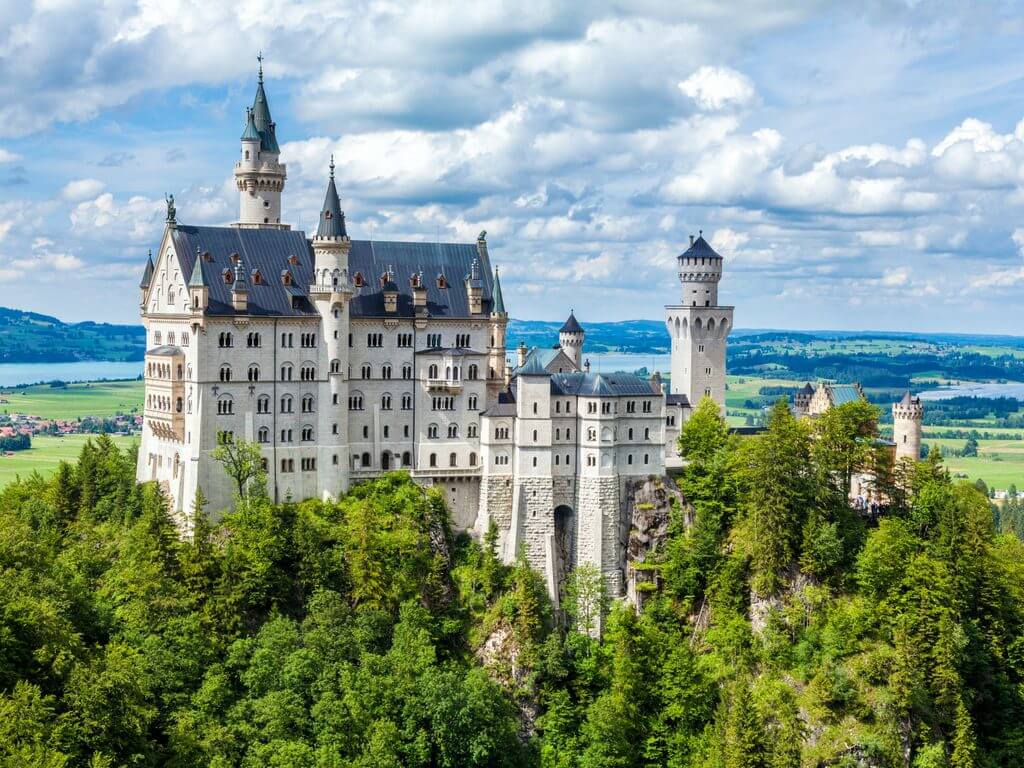
The Neuschwanstein Castle.
“Crazy” King Ludwig
The visionary behind the famous Neuschwanstein Castle was King Ludwig II. King Ludwig was a legend even before his death. He once told his governess, “I want to remain an eternal mystery to myself and others.” He certainly is that.
The Swan King was often eccentric and reclusive. As you can imagine, this made his reign problematic. He avoided large, social events and wished not to engage in politics or governmental life. Ludwig’s interests were instead focused on the arts, architecture, and music.
Despite the fact that these idiosyncrasies made him a thorn in the ministers’ side, he was very popular with his people. Since he would often ride into the Bavarian countryside and spend time with the farmers there, he was well-known and well-liked. He would even send lavish gifts to those he found especially hospitable (who wouldn’t want a royal present?!?)
However, it was these lavish tendencies that led to his downfall. Most notably, the construction of his famous Neuschwanstein Castle.
The Real-Life Disney Castle
What’s better than one castle? Two! While King Ludwig II grew up in the Hohenschwangau Castle, he wanted to build another just up the hill in 1869 that would serve as his personal retreat. Neuschwanstein Castle is elaborately decorated with romantic images from the Middle Ages, along with religious depictions.
Despite its medieval appearance, it had all the modern conveniences of the time. This included running warm water, a bell system, flushing toilets, and even large window panes (which were very uncommon at the time.)
Ludwig had great attention to detail, which accounts for the interesting features throughout the castle. For instance, a large ceramic swan is in almost every chamber. These served to help heat the rooms with hot water, and as decorative vases in the summer. Other fascinating aspects of the castle include a grotto between the drawing room and the study. You read that right- an indoor grotto! It opens up into a conservatory with the most spectacular view of the valley. It even had its own fountain and rainbow machine!
Much of the castle’s details were inspired by the operas of Richard Wagner (whom Ludwig greatly admired.) For example, the grotto was representative of Wagner’s opera, Tannhäuser.
In addition to the fascinating architecture, Ludwig also had the interior painted with beautiful murals. Some of the most stunning are in the Throne Hall, with depictions of Jesus, the twelve apostles, and canonized kings. This room also has a massive chandelier modeled after a Byzantine crown, which weighs more than a car!
Another beautiful mural was painted in the Singers’ Hall (one of Ludwig’s favorite rooms.) The forest scene behind the stage makes you feel like you’re walking into a Disney movie!

The Throne Hall.

The Singers’ Hall.
Financial Strain
King Ludwig II used his personal fortune to fund the castle’s construction, among others, but it didn’t take long for money to run thin. As he continued to expand the scope of the project, his debt continued to grow. The king soon owed 14 million marks, when he began demanding loans be found from Europe’s royalty. This financial strain, coupled with his reclusive nature and desire to remain out of government, started to raise eyebrows.
His nervous ministers decided to come together to put an end to what they saw as a runaway train. They began to gather testimonies from his staff detailing erratic behavior, including excessive shyness, expensive impulses, childish table manners, etc. Whether any of these were true remains unknown. It was enough though. These testimonies were used by a panel of psychologists (who hadn’t even seen the king) to declare him unfit to rule.
After he was deposed, he was taken from the castle in the middle of the night (less than six months after he’d started staying there). The next day, his body was mysteriously found near the shore of Lake Starnberg, along with Dr. Gudden (one of the psychologists who declared him insane). The death was ruled a suicide by drowning, despite no water being found in his lungs and accounts of bullet holes in his back.
At the time of his death, only 14 of the 200 rooms in the castle were finished. Despite being incomplete, the castle still attracts over a million visitors each year. Ironic, when the castle was intended as a private retreat for the reclusive king. Also ironic is the castle that created such financial turmoil, now serves as a key income driver for the local economy.
From One Dreamer to Another
While on vacation in Europe, Walt Disney and his wife visited Neuschwanstein Castle. Disney was so inspired by the fairy tale architecture and surrounding landscape, that he modeled his Sleeping Beauty castle after it (which also served as the Walt Disney Pictures logo from 1985-2006). Upon returning home, he constructed Disneyland with the castle as its centerpiece in Anaheim, California.
Both men have striking similarities. Like Ludwig, Disney was a visionary and a dreamer. His imagination and creativity built a brand that has captured the hearts of millions around the world (just as Ludwig’s castle has). And, like Disney, Ludwig was before his time. He implemented all of the latest technologies of his time and saw things as he imagined they could be, not as convention dictated.
So while Ludwig’s vision may not have been appreciated during his lifetime, it certainly was after. And, with the help of another dreamer, the castle now captures the imaginations of millions around the world.
You can find more information about the castle and its history here.
Tips for Visiting Neuschwanstein (the Inspiration For Disney’s Castle)
TICKETS: As one of the most popular destinations in Europe, the lines to get your tickets for the castle can be long. As in, hours and hours long. For that reason, you should get your tickets ahead of time (at least 2 days) if you want to avoid wasting precious vacation time at the ticket counter. You can book your skip-the-line ticket here.
PARKING: Because there is no parking at the castle itself, you’ll need to park down the hill near the Ticket Center. There’s a large parking lot on the corner of Parkstraße and Schwangauer Str. Helpful hint- you need to pay at the kiosk before you can exit (not at the exit itself.) I made the mistake of not realizing that and caused quite a traffic jam.
GETTING TO THE CASTLE: Neuschwanstein is about a mile up the road from the Ticket Center. If you don’t feel like walking, you can take a shuttle or horse-drawn carriage, for a fee.
WHAT TO EXPECT: Castle tours last about 35-45 minutes and are offered in several different languages. The entrance can be crowded and confusing, so I recommend getting there at least 10 minutes early to find your group. Also, photography is not allowed inside the castle. They are very serious about that. If you wish to take pictures, you must apply for a permit here at least 10 business days prior to your visit.


You May Also Like:
» Picture Perfect Reasons to Visit Germany
» 5 of Europe’s Most Charming Villages
» Top 10 Essential Sites for Travel Deals


This is a great article about the inspiration for Disneyland’s castle. I would love to visit this castle in Germany some day! The castle in Disneyland park in Anaheim, CA is Sleeping Beauty’s castle. That is the castle modeled after Neuschwanstein Castle. There is a great article about this on the Walt Disney.org site. It talks about Herb Ryman who was the artist that sketched out the idea for Sleeping Beauty’s in the early 50’s. It was inspired by the castle in Germany. The model of this castle was created based on his sketches. It’s so interesting to read about all of this!
That’s so interesting, I’ll have to check that out! I’m so glad you enjoyed my article too! 🙂
Thank you for your informative article. I used to be Cast Member at Disneyland and I have been to Disneyworld and Neuschwanstein. The Disney castles are great and Neuschwantstein is spectacular. Walt Disney was truly inspired by King Ludwig II’s creation. I admire both men!
Anyway, I’d like to know what year Disney was inspired by Neuschwantein. The reason why I am asking is because our Neuschwanstein guide informed us visitors that Disney was inspired when he was in Germany during World War II. I came up to him and whispered to him that Disney was born in 1901 and therefore he might have meant around World War I. Thank you for your time.
Love that you were a Disney cast member! I had a friend years ago who was one of the Disney princes who married a Disney princess (talk about a real-life fairy tale!)
Anyways, I heard Disney was on his Bavarian tour in 1935. So, a little prior to World War II.
Hope that helps! 🙂
I don’t believe my original question was addressed. What actual purpose does the castle serve? Either one.
I’m sorry I missed your original question! The purpose of the castle was to serve as the private residence of the king, which it did until his death. Now, the castle serves as a historical landmark and major tourist attraction in Germany, shining a light on the eccentric personality of the king who built it.
There is a show on fb where they do castles they were at one over seas called the Cinderella castle I was just like the people walked out and left everything these shows are,so good!!
Oof. Unfortunately points lost for inaccuracies. Sleeping Beauty Castle is located in Disneyland in Anaheim, California. What you have pictured here is Cinderella Castle, located in Walt Disney World near Orlando, Florida. The two castles are very different in appearance- Sleeping Beauty Castle is shorter and broader and pink in color. Cinderella Castle is taller (198 feet I believe, keeping just shy of 200 feet which would require a beacon for the local Orlando Airport) and was originally more white, gray and light blue in color. Recently the castle received an updated exterior with new tones of light pink, a deeper blue and many gold accents added.
Facepalm. I can’t believe I mixed the two up, thank you so much for pointing that out (and for the insightful facts about the differences between the two)! I’ve made the necessary corrections to ensure the article accurately reflects which castle Neuschwanstein was the inspiration for. 🙂
Beautiful and stunning pictures, Steph! Thanks for the recap of our trip there in April. Worth every minute.