


First they came for the socialists, and I did not speak out- because I was not a socialist. Then they came for the trade unionists, and I did not speak out- because I was not a trade unionist. Then they came for the Jews, and I did not speak out- because I was not a Jew. Then they came for me, and there was no one left to speak for me. -Martin Niemoller
The Holocaust claimed the lives of an estimated 11 million people (1.1 million of which were children.) Looking back, it’s hard to imagine how something like that could ever happen. How could anyone hate a complete stranger so much? And yet, an “us” versus “them” attitude normalized the persecution of entire groups of people. They were suddenly seen as lesser beings. Pests to be cleared away for the “superior race.” After the dust settled, whole towns were eradicated, families were wiped out of existence, and two thirds of Europe’s Jewish population was gone.
Today, you can find museums, memorials, and holocaust sites throughout the world. They serve not only as a reminder of all those who were lost, but also to educate us so history doesn’t repeat itself.
The Holocaust Museum, Washington DC
You could spend days in the Washington DC Holocaust Museum. I was there for four hours and barely scratched the surface of the immense amount of information it contains. The museum details Hitler’s rise to power, with promises of making Germany great again. It didn’t start with gas chambers. He first blamed certain groups of people for the troubles of the country. This included Jews, socialists, and communists, among others.
He then began to separate them from society, inch by inch. First excluding them from public life with the Nuremburg laws of 1935, then forcing them to wear a yellow star of David, so they could be easily identified once WWII began. It didn’t take long for things to snowball. Soon, these groups were sent to concentration camps, where the vast majority were later killed.
The museum includes a cast replica of the arch over Auschwitz’s gates, thousands of shoes left behind by victims, tools used to decipher eye and hair color, casts of Jewish tombstones, and videos of survivor testimonials. On certain days, you even have the opportunity to speak to a survivor in person. It’s a wealth of information.
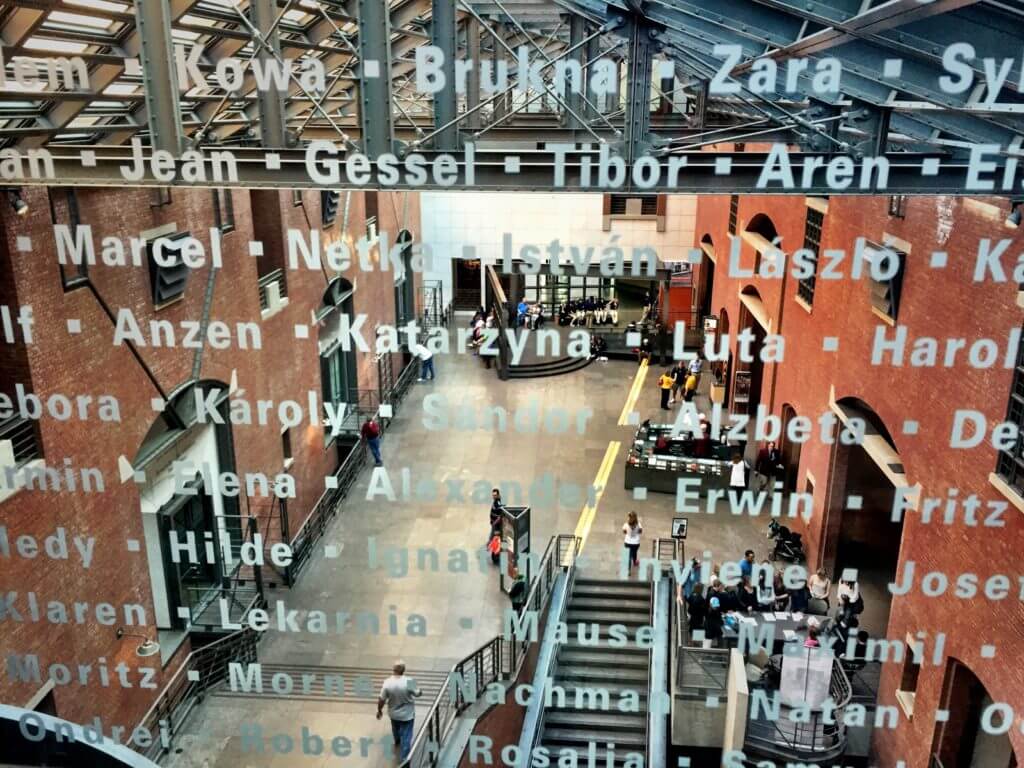
Names of victims are etched into the glass surrounding different floors around the museum.
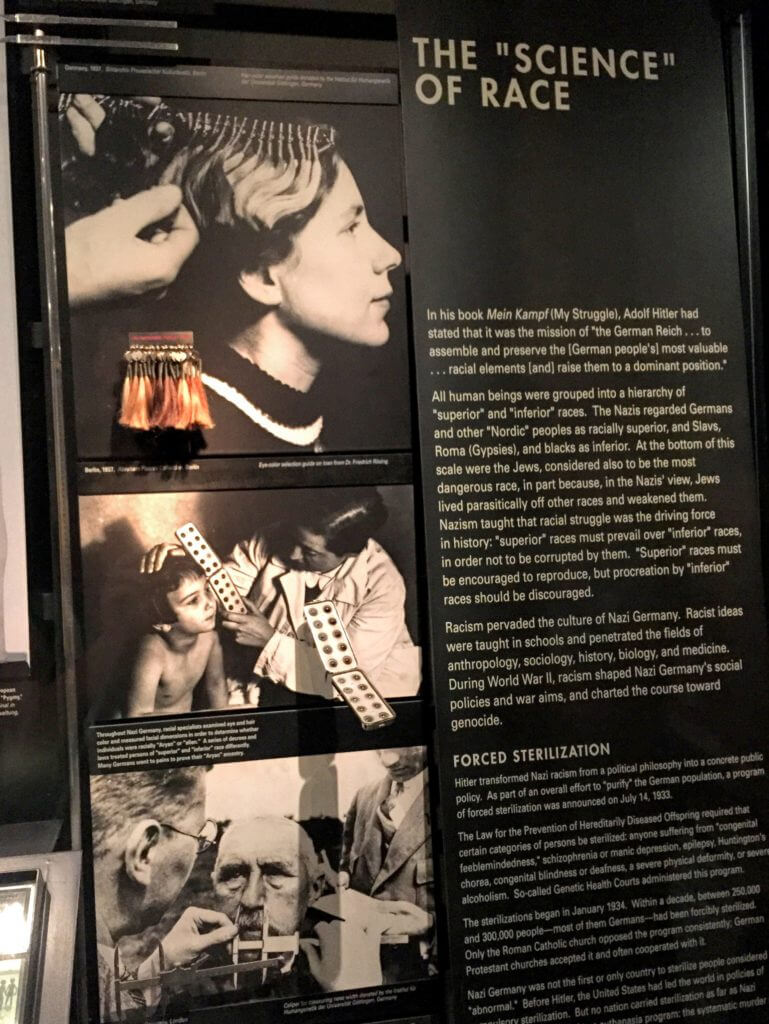
Guides used to decipher preferred eye and hair colors, as well as nose width. These were used to weed out “inferior races.”

Photos of identification number tattoos on Holocaust survivors.
The Holocaust Memorial, Boston
The six glass towers of the New England Holocaust Memorial were completed in 1995. They represent the six major concentration camps of WWII- AuschwitzBirkenau, Majdanek, Treblinka, Chelmno, Belzec, and Sobibor. The names of these camps are carved into the black granite at their base. In addition, steam rises up through grates in the floor of each tower, symbolizing the souls of those who were lost.
The glass towers have 6 million random numbers etched into them, representing the 6 million Jews killed in the concentration camps. Along with these numbers, quotes from survivors are also written.
The one that has always stuck with me was, “My young sister went up to a Nazi soldier with one of her friends. Standing naked, embracing, she asked to be spared. He looked into her eyes and shot the two of them. They fell together in their embrace, my sister and her young friend.”
At the beginning and end of the pathway, the word “Remember” is carved in both English and Hebrew.

Walking through the memorial in Boston, near the Freedom Trail.

Poignant quotes are found throughout the memorial.
The Anne Frank Huis, Amsterdam
Most of us can remember reading Anne Frank: The Diary of a Young Girl. She tragically passed away in a concentration camp just shy of her 16th birthday. And for someone who thought she would never be taken seriously, she is responsible for writing one of the most definitive accounts of the Holocaust in existence.
Her journal details life in the secret annex, and what it was like to live in hiding from the Nazis for two years.
During the days they had to remain silent, to avoid being discovered by workers downstairs. In addition, the windows were blacked out so they could remain unseen by the outside world. Seeing the thick black curtains in person was heartbreaking. To imagine never feeling the sun on your face, or smelling a fresh breeze. It’s simply awful.
Her father, Otto, was the only one to survive in her family. He agreed to open the annex to visitors, but wished to not have replica furniture brought in. Instead, the only decorations are preserved drawings on the walls. At the end of the tour, her diary is on display in a sealed case, along with pages and pages of her writings.
Yet through it all, she remained positive. “I keep my ideals, because in spite of everything I still believe that people are really good at heart.” “How wonderful it is that nobody need wait a single moment before starting to improve the world.”

The outside of the Anne Frank Huis.
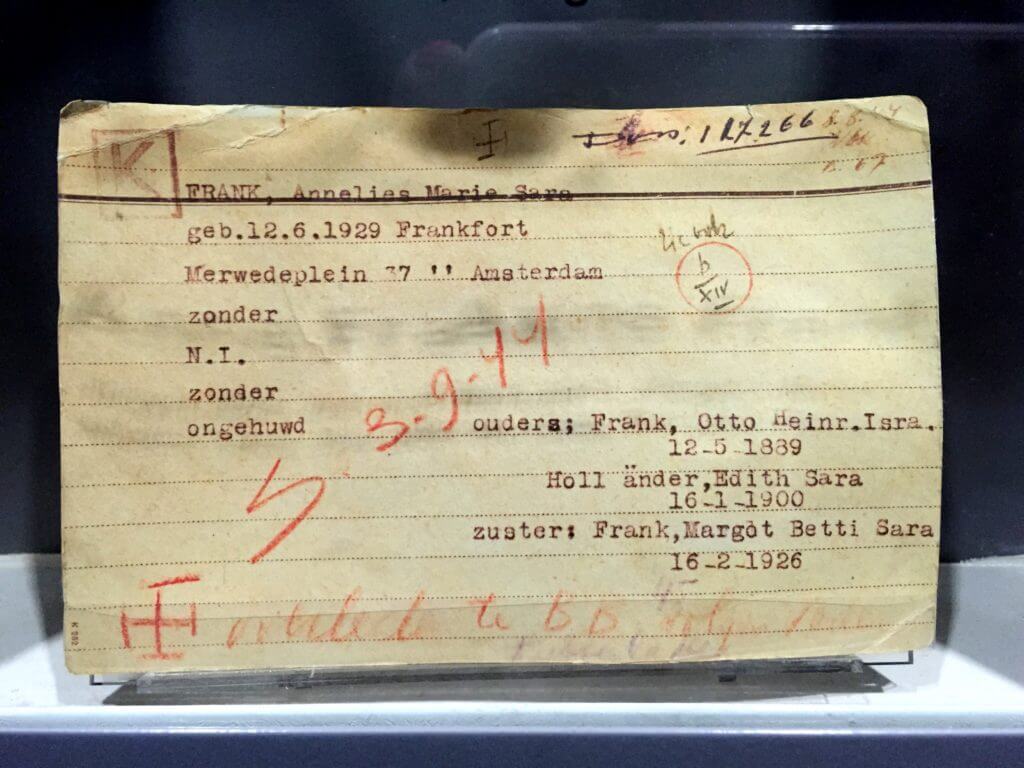
Anne Frank’s intake card at the concentration camp.
Auschwitz I and Auschwitz-Birkenau
Probably the most famous of the WWII concentration camps was Auschwitz. It was here where the Nazis first perfected their methods for mass murder, using Zyklon B in gas chambers. This enabled them to kill over 6,000 people per day, before cremating the remains.
This is also where much of the liberation footage was shot. In the videos, victims are seen crowding the fence line with smiles and waves. The reality is, that footage was shot months after the fact by volunteers who agreed to go back. The true scene was much less jubilant.
The wartime photographer responsible for the videos said eyes were fearful or vacant altogether. There was no energy, no excitement, and no hope. Many died despite medical attention, and even more didn’t believe they were actually free. It took months to fully evacuate the camps, and only after was propaganda footage re-shot.
You can read more about what went on in these two camps here.

The fence line as you enter Auschwitz I.
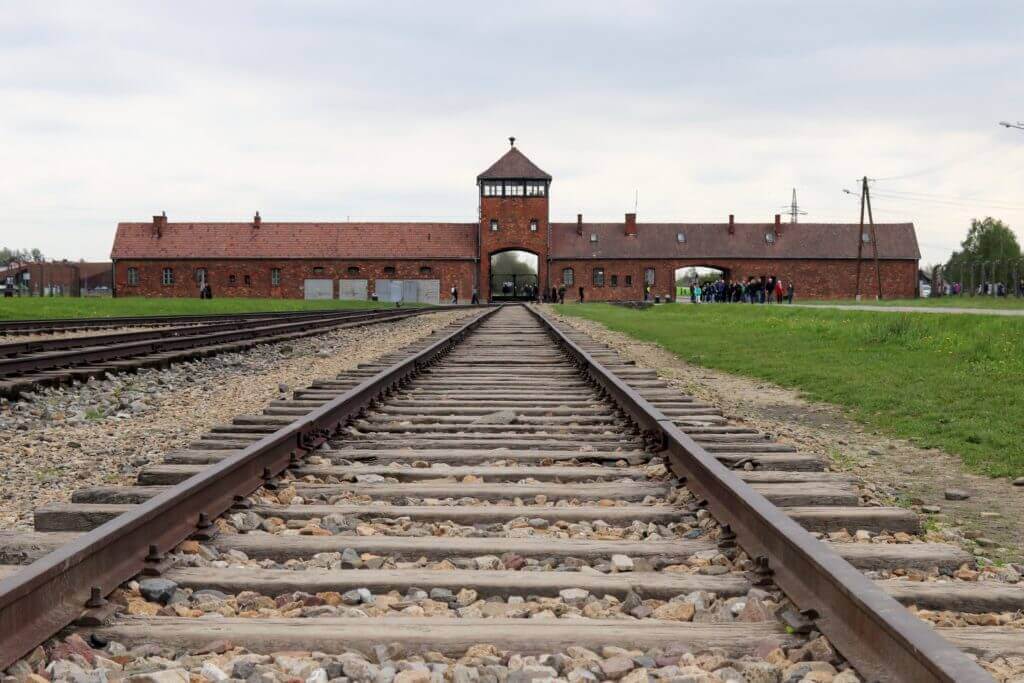
The entrance to Auschwitz-Birkenau.
Visiting these holocaust sites and memorials can be difficult, but it’s important to see them. Because without remembering the consequences of bigotry, prejudice, and hatred, we’re doomed to repeat them.

 You May Also Like:
» A Day of Remembrance in Auschwitz
» Picture Perfect Reasons to Visit Amsterdam
» The Astounding Ways Travel Changes You




Leave a Reply